About 4,500 years ago, the African continent was entirely covered with water. We know this is true because humans witnessed the event, recorded what they saw, and the document they wrote is available to us today. About that water and its depth that account reads:
For forty days the flood kept coming on the earth, [...]
Continue reading about Geologists see effects of Noah’s Flood in Africa
On the shore at Sea Point, south of Cape Town, sits a dramatic geological contact (figure 1) that has been famous for some two centuries. This complex and spectacular feature was first described by Clark Abel in 1818,1 and then visited by the young Charles Darwin in 1836, on his journey around the world on [...]
Continue reading about Famous contact at Sea Point, South Africa, reveals rapid granite emplacement
The oldest rocks in the Cape Town area, South Africa, are part of the Malmesbury Group,1 named after the town of Malmesbury, 60 km north-west of Cape Town. The Malmesbury Group covers a large area around Cape Town: 200 km to the north and 100 km to the east. Beyond this they are covered by [...]
Continue reading about Cape Town’s oldest rocks deposited rapidly from abundant water
In the steep road cut alongside Chapman’s Peak Drive, south of Cape Town, South Africa, you can see some of the flat-lying beds of sediment that form the 1000-metre tall mountains along Cape Peninsula. The mudstone has a distinctive maroon colour while the coarser sandstone is buff. The road runs just above the contact between [...]
Continue reading about Cape Peninsula sandstones, South Africa, deposited during Noah’s Flood
When I was in South Africa in 2011, I photographed this glorious view looking south on Chapman’s Peak Drive, south of Cape Town. The road down Cape Peninsula runs along the junction between two spectacular geological features.
In the cut as you drive along the road you can see flat-lying maroon, purple and tan beds [...]
Continue reading about Cape Peninsula, South Africa, formed during Noah’s Flood
My Google friend sent me some more shots1 of Carnarvon Gorge using Google Earth. They said:
Here’s a series of screenshots with different sea levels, showing how water may have emptied through Carnarvon Gorge, using 2.5x elevation exaggeration for emphasis. The view is from the head of the Gorge looking toward the water gap through Clematis [...]
Continue reading about Carnarvon Gorge from Battleship Spur as Noah’s Flood receded
The Consuelo Tableland to the north of Carnarvon Gorge would have been one of the first areas of land to emerge in Queensland as the waters of Noah’s Flood were receding from Australia. A rough calculation shows it would have been at least 224 days after the Flood began before the tableland emerged. The receding [...]
Continue reading about Basalt flows around Carnarvon Gorge, Central Queensland, erupted under water
A Google friend sent me some screen shots of the Carnarvon Gorge area, saying “I was inspired by your latest blog post to ‘Google-Earth’ Carnarvon Gorge.” The first shot here helps us picture what was happening as the floodwaters were receding. My friend says:
The blue sea level is set at 880m asl, and clearly delineates [...]
Continue reading about Google Earth graphically illustrates Noah’s Flood at Carnarvon Gorge
As you travel the unsealed road to Carnarvon Gorge, just before you reach the Camping Area, you pass through a break in Clematis Ridge. The photo from the top of the ridge shows it running south from where the people are sitting. Clematis Ridge extends across the whole entrance to the Gorge for a distance [...]
Continue reading about Carnarvon Creek flows through a water gap carved during Noah’s Flood
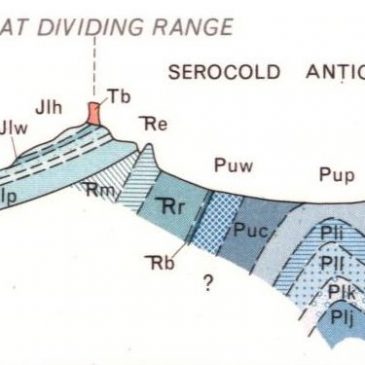
Carnarvon Gorge sits at the junction of two major sedimentary basins, the Surat and Bowen basins. This is illustrated in the geological section to the left1 which looks to the north west and cuts through the south wall of Carnarvon Gorge just east of its entrance.
The sedimentary strata to the west (left) of the [...]

Latest Comments